

- HOME
-
Collaboration Partner Recruitment
- mask voice clip
- Underwater CO2 measurement and evaluation service
- Decentralized Exhaust Gas Circulation one-by-one VOC removal system
- Brain NaviTM Brainwave Analysis Service
- Film thermistor
- NeuroStoneTM
- Transparent Conductive Film
- Lithium-ion secondary battery characterization and degradation diagnosis solution
- Next-generation lithium ion secondary batteries
- Magnetorheological Elastomer (MRE)
- Ultrasound Transmission Metamaterial
- Collaboration Partner Recruitment Top
- New Business Creation Initiatives
- Activity Introduction
- Notices
A revolutionary advance
in voice input less affected
by noise clipped to a mask,
mask voice clip is an input device
that isolates the wearer’s voice
Even in noisy environments or where several people are speaking at once,
highly accurate real-time isolation is possible by detecting subtle vibrations on the mask.
Contact Us
-
Description
Partners interested in mask voice clip applications that solve issues with voice input and communication in noisy environments
-
Products used
Mask voice clip, a voice input device clipped to masks
*Currently under development and not commercially available.
MATCHING
POINT
- ・Those considering voice input deployment where masks are worn (in medical settings, manufacturing, or construction)
- ・Those with ideas for a voice input device clipped to masks

Mask voice clip is a voice input device clipped to masks for highly accurate real-time voice isolation even in noisy environments.
Murata is looking for parties interested in this technology, those with ideas for potential applications, and those who might consider voice input deployment in medical settings, manufacturing, or construction. We look forward to hearing from you.

- Mask voice clip, a voice input device clipped to masks
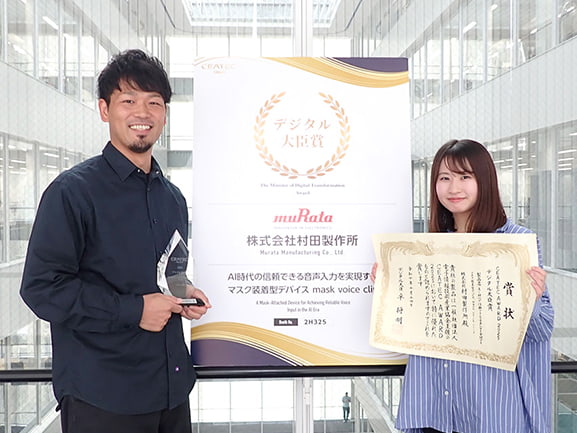
- Winner, Minister of Digital Agency Award, 2025 CEATEC Award Program
Background of Development
 Clips on a mask
Voice input is becoming the most intuitive way to interact with the digital world, as generative AI use continues to surge. Yet in the physical world, adoption of voice input has not spread to medical, manufacturing, or construction sites that are often noisy and require people to wear masks.
One factor for this may be that some things present challenges for conventional voice input technology. Ambient noise or other people's voices may cause misrecognition, and speech through masks may be difficult to pick up.
Mask voice clip was developed as a solution. This voice input device clipped to masks provides highly accurate voice isolation even where there is background noise or audible disturbances.
It picks up minute vibrations on the surface of the mask worn by a speaker, enabling accurate input of their voice in real time undisturbed by ambient noise or other speakers’ voices.
This next-gen technology was recognized with a Minister of Digital Agency Award at CEATEC 2025 and has drawn attention from many fields.
Features of mask voice clip
Feature01Physically isolates and reliably picks up the speaker's voice, even in noisy environments
Mask voice clip incorporates a Murata PicoleafTM piezoelectric film sensor that detects minute vibrations on the mask.
Most headset microphones detect vibrations in air, which makes them susceptible to picking up ambient sounds.
In contact microphones such as throat microphones, high-frequency components tend to be attenuated as they pass through the body, which may affect identification of consonants. They may also be uncomfortable and prone to generating noise from rubbing against the neck. In contrast, mask voice clip works by measuring minute mask vibrations as the user speaks. External sound is physically shut out and does not affect the highly accurate sensing of a speaker’s voice.
This makes it a versatile, promising approach for noisy environments, places with multiple speakers, or situations requiring privacy.
 Voice input mechanism
 CER comparison: typical lavalier mic versus
 mask voice clip1
Feature02Convenient clip-on device that also supports mask hygiene
With its clip structure, mask voice clip is easy to attach or remove from masks. This eliminates the need for special equipment or complicated fasteners, enabling easy attachment and removal before and after work or when switching users. The device itself can be reused by people using disposable masks, supporting mask hygiene.

Feature03Low-latency, energy-efficient voice input without software processing
Mask voice clip hardware design enables low-noise voice input. With no need for post-processing such as AI noise reduction, it does not rely on a GPU or other sources of high-performance computing, which minimizes audio input latency. This makes it an ideal voice interface for manufacturing or medical settings or similar applications requiring immediate operation and reliability.
Usage scenarios for mask voice clip
Usage scenario01Giving site-specific instructions or taking voice memos

Because users can record themselves accurately without recordings being affected by ambient noise, mask voice clip enables them to instruct others or record memos without worrying about disturbances around them, especially at noisy construction sites or production lines.
Usage scenario02Hands-free communication or voice commands

Mask voice clip is convenient where users need to use both hands for other work. Hands-free operation while using factory or medical equipment is one example of this.
Inquiries
Working toward commercialization, Murata is involved in the development and testing of the mask voice clip voice input device clipped to masks.
We are looking for partners who are considering voice input deployment where masks are worn, or who have ideas for potential applications.
If you are interested, we welcome inquiries through the contact form.
*This product is under development.Therefore, the product specifications are subject to change without advance notice.


Message from the developers
Murata Manufacturing Co., Ltd.
Strategic Technology & Innovation Department
Corporate Technology & Business Development Unit
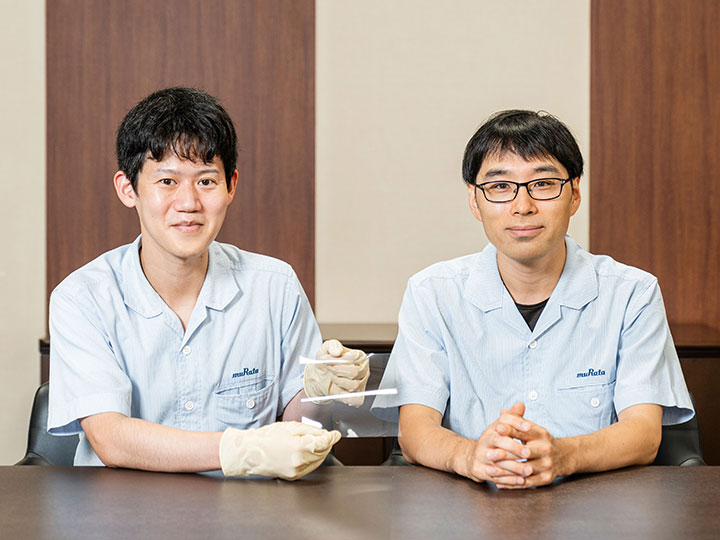
- Masanori Morita
Miku Nonogaki -
Mask Voice Clip voice input technology was developed through joint research with Rekimoto Lab, University of Tokyo Interfaculty Initiative in Information Studies.1
At the 2025 CEATEC awards, jury members praised this work for balancing sound source selectivity with noise immunity through the structure adopted, noting how it is a very useful next-generation voice interface for noisy environments where masks are required, such as in manufacturing or medical settings.2
We view the award as recognition of our approach. We have treated speech and voice recognition for mask wearers not as problems but as prerequisites for creating new value. We believe the technology has the potential to expand communication itself through future applications including subvocal recognition and new voice input solutions. Knowing that the technology will show its true value only when it helps people in the field as a practical solution, we are working toward commercialization and business development, envisioning widespread adoption.We welcome inquiries by those interested in the technology. We look forward to meeting partners to join us in building the future of next-generation voice interfaces.
References
- (1)Hirotaka Hiraki and Jun Rekimoto. 2025. MaskClip: Detachable Clip-on Piezoelectric Sensing of Mask Surface Vibrations for Real-time Noise-Robust Speech Input. In Proceedings of the Augmented Humans International Conference 2025( AHs ’25 ). Association for Computing Machinery, New York, NY, USA, 333-344.
https://doi.org/10.1145/3745900.3746088 -
(2)2025 CEATEC awards included the Minister for Internal Affairs and Communications Award, Minister of Economy, Trade and Industry Award, Minister of Digital Agency Award, and category awards such as the new Mobility Award.
https://www.jeita.or.jp/japanese/topics/2025/1007award.pd

Inquiries
Working toward commercialization, Murata is involved in the development and testing of the mask voice clip voice input device clipped to masks.
We are looking for partners who are considering voice input deployment where masks are worn, or who have ideas for potential applications.
If you are interested, we welcome inquiries through the contact form.
Project Examples for Collaboration
-

A revolutionary advance in voice input less affected by noise clipped to a mask, mask voice clip is an input device that isolates the wearer’s voice
Mask voice clip is a voice input device clipped to masks for highly accurate real-time voice isolation even in noisy environments.
We seek parties interested in this technology, those with ideas for potential applications, and those who might consider voice input deployment in medical settings, manufacturing, or construction.more
-
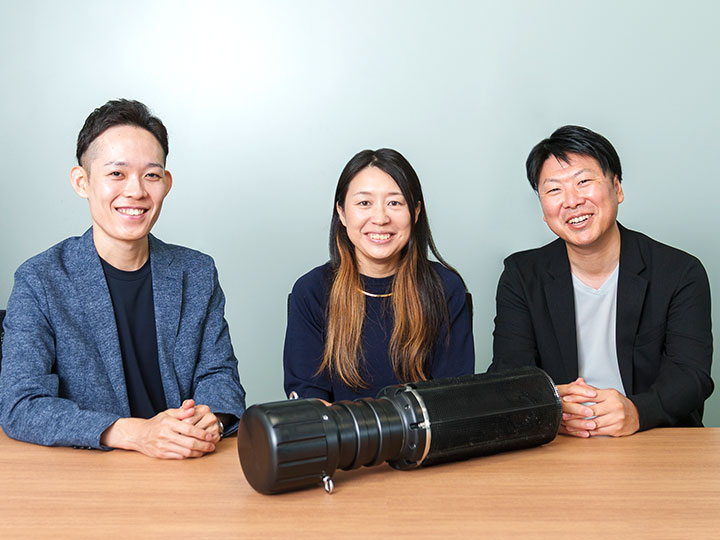
Development of a measuring device that makes it possible to visualize the amount of CO2 in seaweed beds "Underwater CO2 measurement and evaluation service" revolutionizes evaluation of blue carbon
Murata's underwater CO2 concentration measuring device enables easy and highly accurate measurement of CO2 in the ocean. Continuous measurement of underwater CO2 concentration has traditionally been considered difficult, so, by making it more accessible, this device holds the potential to greatly change methods for evaluating blue carbon. We are seeking partners for collaboration, including businesses, organizations, and others facing challenges in evaluating blue carbon, as well as companies and others interested in carbon credit trading.
more
-
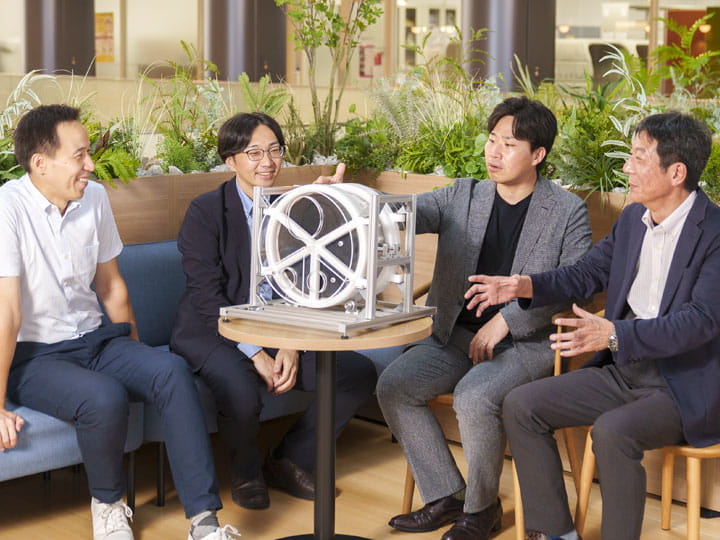
Decentralized exhaust gas circulation one-by-one VOC removal system - Utilizing a compact and lightweight rotor to achieve both energy saving and VOC removal
In order to downsize exhaust circulation concentration systems that treat VOCs, we have achieved downsizing and weight reduction of 20-30% or more for the core component, the rotor. We are looking for collaboration partners who can work together with us to create new VOC treatment solutions that utilize this rotor to achieve both energy savings and VOC removal.
more
-
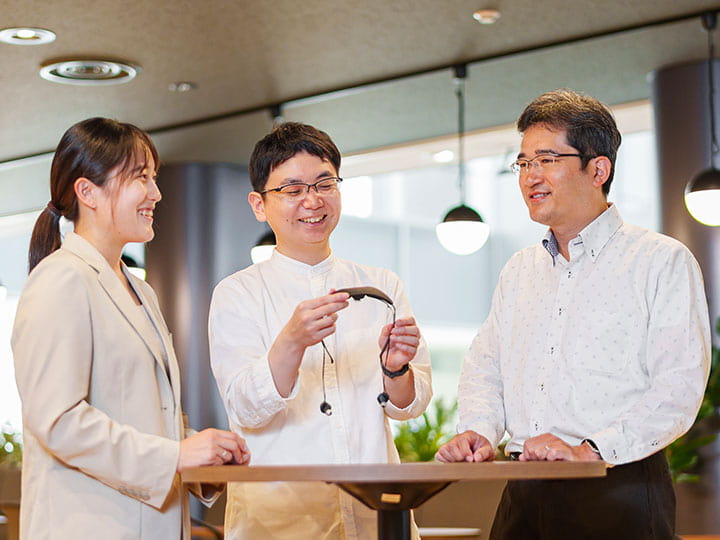
Brain NaviTM — A simple and high-precision brainwave analysis service that enables accurate “visualization” of momentary sensations and cognition
Brain NaviTM enables accurate understanding of human brain responses to stimuli such as seeing and hearing. We are looking for partners who seek to solve challenges by utilizing this analysis data to accurately personalize products and services.
more
-

Increasing the added value of products with ultra-thin, high sensitivity sheet-shaped temperature sensors called film thermistors
Murata has developed an ultra-thin sheet-shaped film thermistor with a thickness of 50 microns that can be freely bent or sandwiched and is capable of real-time, multi-point temperature measurement of objects. We are seeking partner companies that wish to develop new products utilizing this technology or that want to make use of it in thermal analysis to solve challenges.
more
-

NeuroStoneTM 3D-printed small free-form inter-connected ceramic devices
NeuroStoneTM is a 3D-printed, free-form inter-connected ceramic circuit board that enables freely three-dimensional internal wiring, thanks to Murata' s expertise in material development and co-firing. We are seeking partners to collaborate with us in leveraging this small free-form inter-connected ceramic 3D printing technology to create products that contribute to equipment downsizing and less invasive medical care.
more
-
Transparent conductive film using the new material of MFT that can be both conductive and freely shaped
Murata Manufacturing is looking for partners to create new value together with us by utilizing bendable transparent conductive film and transparent conductive film that can be adapted to complex shapes using the new material of MFT (*in-house name).
more
-

Lithium-ion secondary battery characterization and degradation diagnosis solution
We are looking for collaboration partners, who are aiming to use batteries safely and efficiently by utilizing battery characterization and deterioration diagnosis technology to non-destructively measure the capacity deterioration factors and resistance increase of Lithium-ion secondary batteries.
more
-

Quadruple the power of lithium ion secondary batteries with porous current collectors
We are looking for co-creation partners for the development of porous current collectors and their implementation into lithium ion secondary batteries that would achieve the fourfold power generation compared to that of the conventional lithium ion secondary batteries.
more
-

Magnetorheological Elastomer (MRE) That Can Reproduce Hardness from Marshmallows to Erasers
Murata Manufacturing is looking for partners who can collaborate with us to create new products and applications by using the magnetorheological elastomer (MRE) material whose hardness changes when a magnetic field is applied to it.
more
-

Exclusive Acoustic Metamaterial from Murata Manufacturing - Ultrasound Transmission Metamaterial technology that enhances the ultrasound transmission through materials
Murata Manufacturing is looking for creative partners that increase the transmittance of ultrasonic waves to enhance the functionality of their devices and open up new markets.
more
