

- HOME
-
Collaboration Partner Recruitment
- mask voice clip
- Underwater CO2 measurement and evaluation service
- Decentralized Exhaust Gas Circulation one-by-one VOC removal system
- Brain NaviTM Brainwave Analysis Service
- Film thermistor
- NeuroStoneTM
- Transparent Conductive Film
- Lithium-ion secondary battery characterization and degradation diagnosis solution
- Next-generation lithium ion secondary batteries
- Magnetorheological Elastomer (MRE)
- Ultrasound Transmission Metamaterial
- Collaboration Partner Recruitment Top
- New Business Creation Initiatives
- Activity Introduction
- Notices
Quadruple the power of lithium ion
secondary batteries with porous current
collectors
Let's improve the lithium ion secondary batteries together to realize the sustainable earth in the future.
Contact Us
-
Description
Partners for the development of porous current collectors to create the next-generation lithium ion secondary batteries, and those for the reailzation of sustainable earth in the future.
-
Products used
Next-generation lithium ion secondary batteries using porous current collectors
*This product is under development.Therefore, the product specifications are subject to change without advance notice.
MATCHING
POINT
- ・Companies holding porous polymer film technologies and their scalabilities
- ・Companies having metal coating technologies and their scalabilities
- ・Companies seeking high-power and high-energy density batteries
- ・Companies persuing the extremely fast charging of lithium ion secondary batteteris

Improvement of lithium ion secondary batteries will bring about a reduction of greenhouse gases by promoting the elecrifications instead of using fossil fuels, leading to a realization of the sustainable energy society. Murata Manufacturing has successfully developed a porous current collector that dramatically improves the performance of lithium ion secondary batteries through the joint research with Stanford University. Murata Manufacturing is now looking for partners who will create the sustainable energy society together by implementing porous current collectors into the next-generation lithium ion secondary batteries.1
Porous current collector
Introduction of Next-Generation Lithium-Ion Secondary Batteries Using New Technology "Porous Current Collectors"
03:19In conventional lithium ion secondary batteries, there has been an issue : when we use the thicker electrodes to increase the energy density, the resistance increases as the lithium ion transport discance gets longer, reducing the maximum current, decreasing the power of the battery.
 The resistance is low
 when the electrodes are thin
 The resistance increases when the electrode gets thicker
We have developed a porous current collector to solve this issue.

Porous structure
*Images provided:Stanford University
Lithium ion secondary batteries using traditional current collectors have a structure in Fig. A. Cathodes are located on the aluminum foils, while anodes on the copper foils on both sides. The lithium ions then travel between the two electrodes through separators (blue arrows). On the other hand, porous current collectors in Fig. B, consists of a porous polymer film as a matrix, coated with two types of metals on the surface, aluminum on one side and copper on the other without filling the pores.
Placing cathodes on the aluminum sides while anodes on the copper ones, lithium ions are allowed to move through the current collectors (red arrows). As a result, lithium ion transport distance is shortened by one half, reducing resistance, and allowing more current to flow than before.


 Ion pathway through separator
 Ion pathway through porous current collector
Next-generation lithium ion secondary batteries using porous current collectors
Feature01Quadrupling the power of lithium ion secondary batteries
Implemantation of porous current collectors into the lithium ion secondary batteries will allow twice the current to flow at muximum, resulting in the fourfold power generation, and reducing the charging time to one quarter compared to the conventional lithium ion secondary batteries with traditional current collectors.

Relationship between the capacity and charging/discharging speed comparing lithium ion batteries using traditional current collectors (TCCs) and porous current collectors (PCCs)2
Feature02Weight reduction of lithium ion secondary batteries
Aluminum and cooper foils are used as the traditional current collectors in Lithium ion secondary batteries. Suppose porous current collectors are used in a cylindrical cell (21700 size) instead of traditional current collectors, the weight would be reduced by about 10% due to the lighter weight of their polymer matrix. Since the amount of electrodes are equal in this estimation, the energy density is expected to increase by about 10%. Porous current collectors are the technology that can improve the power and fast-charging properties without compromising, or even increasing energy densities.
Feature03Safety improvement of lithium ion secondary batteries
It has been reported that lithium ion secondary batteries using metal-polymer composite current collectors showed the superior battery safeties, exhibiting the prevention of thermal runaway.3,4,5
These references suggest the possibility that porous current collectors would improve the battery safeties of lithium ion secondary batteries through the prevention of thermal runaways.
Perspectives
Porous current collector is compatible with existing battery manufacturing processes both for cylindrical and laminated types, indicating that next-generation lithium ion secondary batteries with porous current collectors would be applied to all devices in which the present lithium ion secondary batteries are currently used.
Moreover, as the enhancements with this technology become greater the larger the batteries, it would be possible to apply next-generation lithium ion secondary batteries into the fields where it has not been possible to apply them before.
 Cylindrical Type lithium ion secondary batteries
 Laminated Type lithium ion secondary batteries
Inquiries
We are looking for co-creation partners for the development of porous current collectors and their implementation into lithium ion secondary batteries that would achieve the fourfold power generation compared to that of the conventional lithium ion secondary batteries.
If your company is interested in collaborating with Murata Manufacturing, please feel free to contact us using the inquiries form.
*This product is under development.Therefore, the product specifications are subject to change without advance notice.


Message from the developers
Murata Manufacturing Co., Ltd.
Energy storage technology development department 1 Device Center, Corporate Technology & Business Development Unit
Yoshiaki Suzuki
Yasuyuki Masuda
Takahiro Yuuki
We at Murata Manufacturing are carrying on the history of lithium ion secondary batteries interited from Sony. Recently, we have developed a porous current collector together with Stanford University. Murata Manufacturing is now trying to change the history of energy through the development of lithium ion secondary batteries with porous current collectors, ensuring that this battery evolution spread throughout the world. We would like to accomplish this innovation together with you to create the future of the earth.
References
- (1) Yusheng Ye, Rong Xu, Wenxiao Huang, Huayue Ai, Wenbo Zhang, Jordan Otto Affeld, Andy Cui, Fang Liu, Xin Gao, Zhouyi Chen, Tony Li, Xin Xiao, Zewen Zhang, Yucan Peng, Rafael A. Vila, Yecun Wu, Solomon T. Oyakhire, Hideaki Kuwajima, Yoshiaki Suzuki, Ryuhei Matsumoto, Yasuyuki Masuda, Takahiro Yuuki, Yuri Nakayama & Yi Cui, “Quadruple the rate capability of high-energy batteries through a porous current collector design”, Nature Energy 9, 643–653 (2024).
- (2) Yusheng Ye, Rong Xu, Wenxiao Huang, Huayue Ai, Wenbo Zhang, Jordan Otto Affeld, Andy Cui, Fang Liu, Xin Gao, Zhouyi Chen, Tony Li, Xin Xiao, Zewen Zhang, Yucan Peng, Rafael A. Vila, Yecun Wu, Solomon T. Oyakhire, Hideaki Kuwajima, Yoshiaki Suzuki, Ryuhei Matsumoto, Yasuyuki Masuda, Takahiro Yuuki, Yuri Nakayama & Yi Cui, “Quadruple the rate capability of high-energy batteries through a porous current collector design”, Nature Energy 9, 643–653 (2024).
- (3) Martin T.M. Pham, John J. Darst, William Q. Walker, Thomas M.M. Heenan, Drasti Patel, Francesco Iacoviello, Alexander Rack, Margie P. Olbinado, Gareth Hinds, Dan J.L. Brett, Eric Darcy, Donal P. Finegan, Paul R. Shearing, “Prevention of lithium-ion battery thermal runaway using polymer-substrate current collectors”, Cell Reports Physical Science 2, 100360 (2021).
- (4) Zhikang Liu, Yanhao Dong, ORCID Xiaoqun Qi, Ru Wang, Zhenglu Zhu, Chao Yan, Xinpeng Jiao, Sipei Li, Long Qie, Ju Li and Yunhui Huang, “Stretchable separator/current collector composite for superior battery safety”, Energy & Environtal Science 15, 5313 (2022).
- (5) Yong Peng, Xuning Feng, Jianzhong Xia, Zesheng You, Fangshu Zhang, Yiwei Chen, Congze Fan, Jianfeng Hua, Yubo Lian, Zhongde Shan, Minggao Ouyang, “Polymer based multi-layer Al composite current collector improves battery safety”, Chemical Engineering Journal 491, 151474 (2024).

Inquiries
We are looking for co-creation partners for the development of porous current collectors and their implementation into lithium ion secondary batteries that would achieve the fourfold power generation compared to that of the conventional lithium ion secondary batteries.
If your company is interested in collaborating with Murata Manufacturing, please feel free to contact us using the inquiries form.
*This product is under development.Therefore, the product specifications are subject to change without advance notice.
Project Examples for Collaboration
-

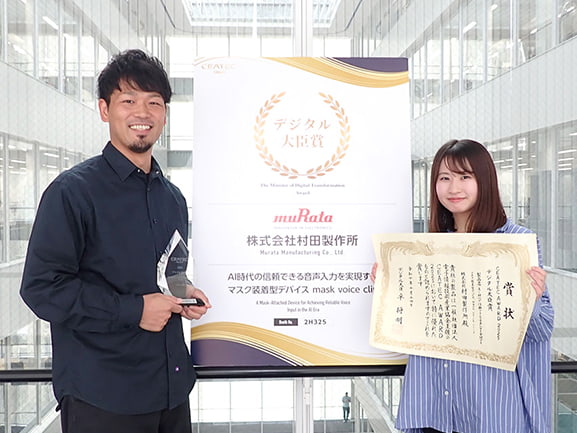
A revolutionary advance in voice input less affected by noise clipped to a mask, mask voice clip is an input device that isolates the wearer’s voice
Mask voice clip is a voice input device clipped to masks for highly accurate real-time voice isolation even in noisy environments.
We seek parties interested in this technology, those with ideas for potential applications, and those who might consider voice input deployment in medical settings, manufacturing, or construction.more
-
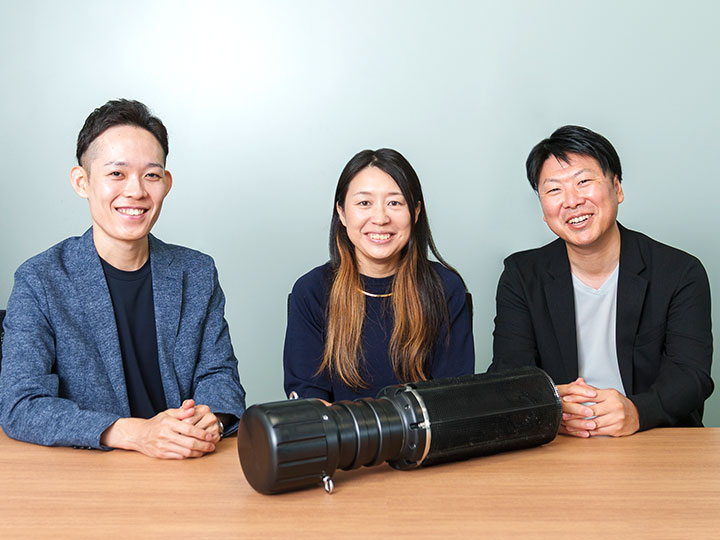
Development of a measuring device that makes it possible to visualize the amount of CO2 in seaweed beds "Underwater CO2 measurement and evaluation service" revolutionizes evaluation of blue carbon
Murata's underwater CO2 concentration measuring device enables easy and highly accurate measurement of CO2 in the ocean. Continuous measurement of underwater CO2 concentration has traditionally been considered difficult, so, by making it more accessible, this device holds the potential to greatly change methods for evaluating blue carbon. We are seeking partners for collaboration, including businesses, organizations, and others facing challenges in evaluating blue carbon, as well as companies and others interested in carbon credit trading.
more
-
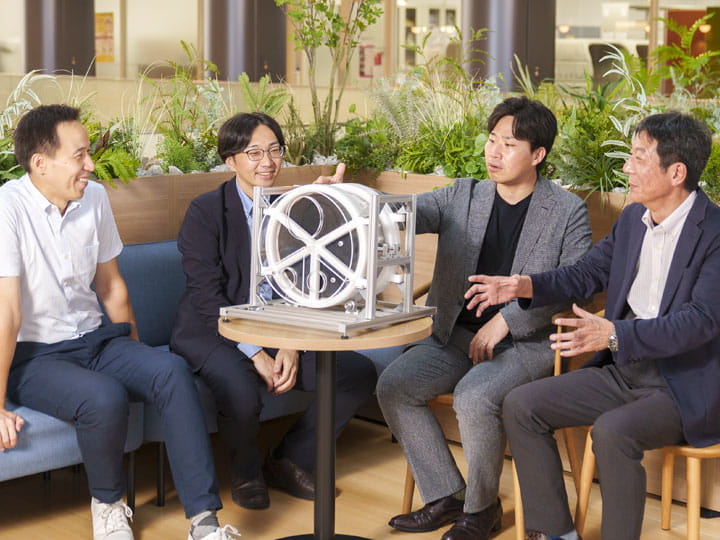
Decentralized exhaust gas circulation one-by-one VOC removal system - Utilizing a compact and lightweight rotor to achieve both energy saving and VOC removal
In order to downsize exhaust circulation concentration systems that treat VOCs, we have achieved downsizing and weight reduction of 20-30% or more for the core component, the rotor. We are looking for collaboration partners who can work together with us to create new VOC treatment solutions that utilize this rotor to achieve both energy savings and VOC removal.
more
-

Brain NaviTM — A simple and high-precision brainwave analysis service that enables accurate “visualization” of momentary sensations and cognition
Brain NaviTM enables accurate understanding of human brain responses to stimuli such as seeing and hearing. We are looking for partners who seek to solve challenges by utilizing this analysis data to accurately personalize products and services.
more
-

Increasing the added value of products with ultra-thin, high sensitivity sheet-shaped temperature sensors called film thermistors
Murata has developed an ultra-thin sheet-shaped film thermistor with a thickness of 50 microns that can be freely bent or sandwiched and is capable of real-time, multi-point temperature measurement of objects. We are seeking partner companies that wish to develop new products utilizing this technology or that want to make use of it in thermal analysis to solve challenges.
more
-

NeuroStoneTM 3D-printed small free-form inter-connected ceramic devices
NeuroStoneTM is a 3D-printed, free-form inter-connected ceramic circuit board that enables freely three-dimensional internal wiring, thanks to Murata' s expertise in material development and co-firing. We are seeking partners to collaborate with us in leveraging this small free-form inter-connected ceramic 3D printing technology to create products that contribute to equipment downsizing and less invasive medical care.
more
-
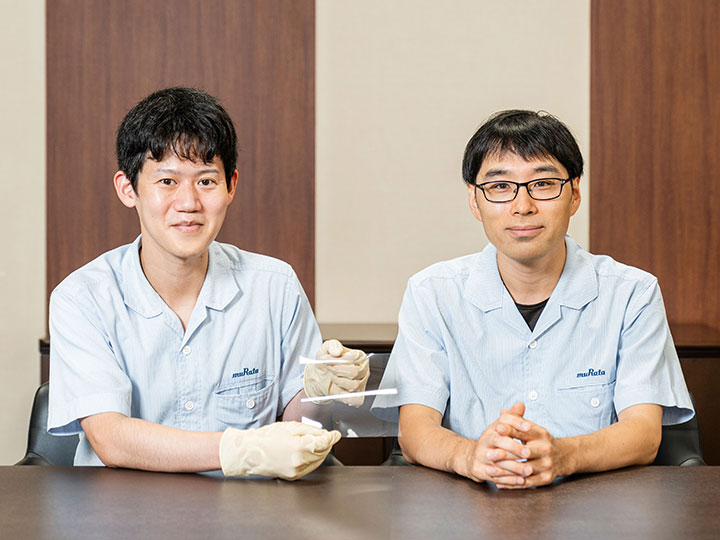
Transparent conductive film using the new material of MFT that can be both conductive and freely shaped
Murata Manufacturing is looking for partners to create new value together with us by utilizing bendable transparent conductive film and transparent conductive film that can be adapted to complex shapes using the new material of MFT (*in-house name).
more
-

Lithium-ion secondary battery characterization and degradation diagnosis solution
We are looking for collaboration partners, who are aiming to use batteries safely and efficiently by utilizing battery characterization and deterioration diagnosis technology to non-destructively measure the capacity deterioration factors and resistance increase of Lithium-ion secondary batteries.
more
-

Quadruple the power of lithium ion secondary batteries with porous current collectors
We are looking for co-creation partners for the development of porous current collectors and their implementation into lithium ion secondary batteries that would achieve the fourfold power generation compared to that of the conventional lithium ion secondary batteries.
more
-

Magnetorheological Elastomer (MRE) That Can Reproduce Hardness from Marshmallows to Erasers
Murata Manufacturing is looking for partners who can collaborate with us to create new products and applications by using the magnetorheological elastomer (MRE) material whose hardness changes when a magnetic field is applied to it.
more
-

Exclusive Acoustic Metamaterial from Murata Manufacturing - Ultrasound Transmission Metamaterial technology that enhances the ultrasound transmission through materials
Murata Manufacturing is looking for creative partners that increase the transmittance of ultrasonic waves to enhance the functionality of their devices and open up new markets.
more
