

- HOME
-
Collaboration Partner Recruitment
- mask voice clip
- Underwater CO2 measurement and evaluation service
- Decentralized Exhaust Gas Circulation one-by-one VOC removal system
- Brain NaviTM Brainwave Analysis Service
- Film thermistor
- NeuroStoneTM
- Transparent Conductive Film
- Lithium-ion secondary battery characterization and degradation diagnosis solution
- Next-generation lithium ion secondary batteries
- Magnetorheological Elastomer (MRE)
- Ultrasound Transmission Metamaterial
- Collaboration Partner Recruitment Top
- New Business Creation Initiatives
- Activity Introduction
- Notices
Increasing the added value of products
with ultra-thin, high sensitivity
sheet-shaped temperature sensors
called film thermistors
Murata Manufacturing has developed a film thermistor by bringing together various technologies.
We are seeking partners to co-create unique products utilizing this technology.
Contact Us
-
Description
Partners that can collaborate with us to create unique products by utilizing ultra-thin, high sensitivity film thermistors
-
Products used
Sheet-shaped temperature sensors called film thermistors that have a thickness of just 50 microns and can be freely bent
*This product is under development.Therefore, the product specifications are subject to change without advance notice.
MATCHING
POINT
- Companies facing challenges in temperature control and thermal analysis in batteries, medical devices, and production equipment

In order to obtain the maximum performance from electronic devices such as PCs and smartphones, and to help prevent accidents, accurate temperature measurement of batteries and other components is essential. For this reason, Murata Manufacturing has developed an ultra-thin sheet-shaped temperature sensor called a film thermistor. This film thermistor is highly sensitive and has a fast response speed, allowing it to quickly capture changes such as slight temperature variations and sudden rises in temperature. It is also thin and can be freely bent, which enables insertion into thin gaps to measure temperature. Furthermore, multiple film thermistors can be arranged side-by-side to understand temperature distributions. We are looking for co-creation partners that want to solve challenges by utilizing this film thermistor in new product development and thermal analysis.
What is a film thermistor?
 An ultra-thin thermistor is formed on resin film.
A film thermistor is a sheet-shaped NTC thermistor capable of temperature measurement. Murata has succeeded in forming an ultra-thin thermistor on resin film.
The core of this technology is low-temperature ceramic sintering technology, and original Murata technology developed over many years of ceramics R&D, as well as sheet-related technology for board products, is also utilized. This film thermistor can be considered the crystallization of Murata’s technology.
Here is a demonstration video introducing the film thermistor shape and response speed, as well as the transition of heat through multi-point detection. Please take a look.
Features of the film thermistor
Feature01Film-shaped with a thickness of 50 microns, which is thinner than copier paper
While conventional chip thermistors have a thickness of around 300 microns (assuming 0402 size), the film thermistor achieves a thickness of 50 microns, which is just 1/6 of that. Furthermore, the use of technology for sintering ceramics at low temperatures has made it possible to form an ultra-thin thermistor on resin film. The thinner shape gives the film thermistor features not available with conventional chip thermistors (for more details, see Feature 02 below).
 Achieves a thickness of 50 microns,
 or 1/6 that of conventional chip thermistors
Feature02Able to track slight or rapid temperature changes, and measure in real time
The film thermistor is extremely thin, which results in a smaller heat capacity compared to conventional chip thermistors, making it possible to detect extremely small temperature changes. It also features a fast response speed that enables swift tracking and accurate measurement of even sudden temperature changes in the measured object.
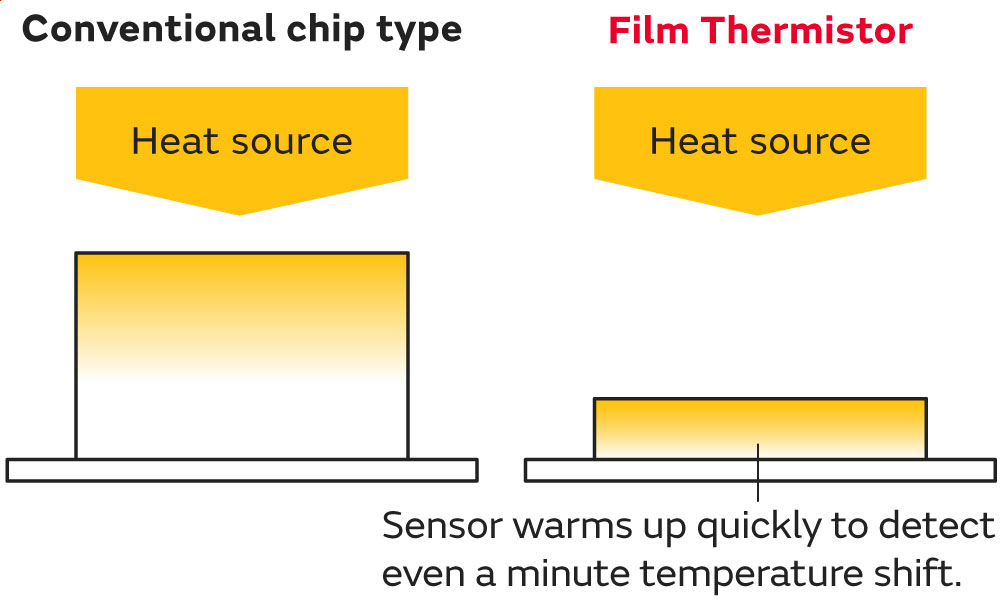 Because the sensor is so thin, it picks up even the most subtle temperature variation.
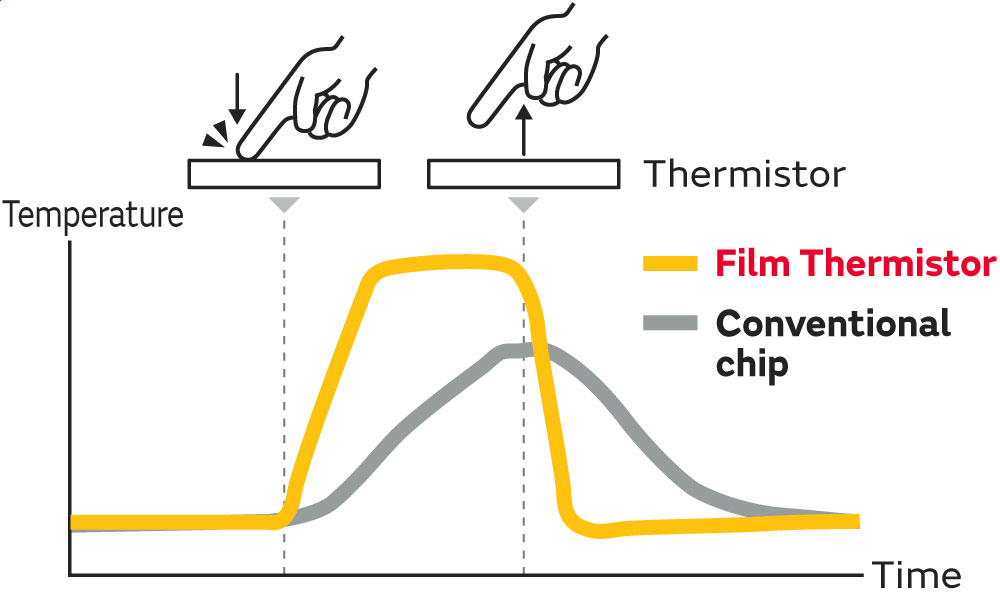 Because the sensor is so thin, it immediately measures any sudden thermal variation.
Feature03A flexible shape that enables temperature measurement even in difficult-to-measure locations
The film thermistor can be bent up to a radius of 1 cm. This characteristic enables to wrap it around objects such as pipes or plants, or attach it to complex curved surfaces to measure their surface temperatures. Because the film thermistor is thin and can be freely bent, it can accurately measure temperature in narrow gaps and other locations that were a challenge with conventional chip thermistors. In addition, the film thermistor also has high pressure resistance, enabling temperature measurement in locations subject to pressure.

 The film thermistor is flexible and can be bent up to a diameter of 1 cm.
Feature04Multi-point detection function that captures the flow of heat in a plane by connecting multiple film thermistors
Use of multiple film thermistors arranged in a planar configuration makes it possible to measure temperature distributions and visualize the flow of heat. This enables measurement of temperatures in hidden areas that cannot be captured by thermography.
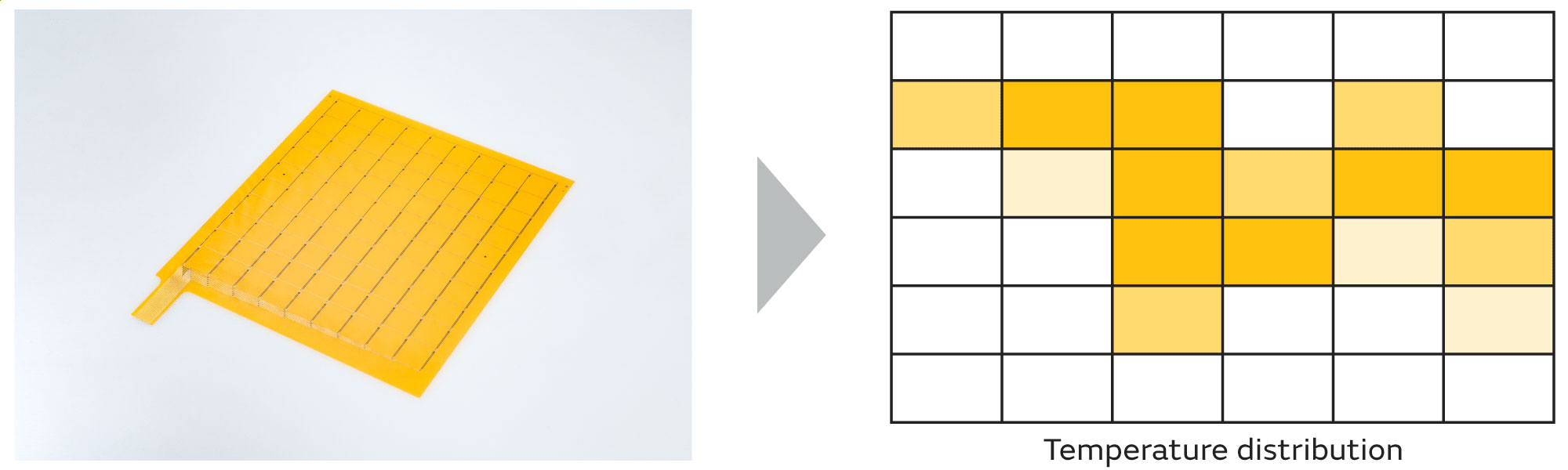
 The “flow of heat” can be captured by arranging multiple film thermistors side-by-side.
Examples of film thermistor application
Example of use01Accurately detect battery hot spots to improve power performance
 Monitoring battery temperature to detect degradation and signs of danger
Use is expected for temperature monitoring of batteries in smartphones, laptop PCs, electric vehicles, and so on. Detailed temperature control will enable early detection of degradation and signs of danger, and make it possible to enhance battery performance and to extend the operating time of devices and the driving range of electric vehicles.
Example of use02Making use of the thin-film shape to support medical devices and diagnostics
 Mounting in masks, etc. to understand changes in body temperature
Applications that make use of the thin-film shape are expected in the health and medical device field. For example, mounting film thermistors in masks, etc. to measure body temperature will help to understand health status, and may assist in diagnosis and disease prevention. Other applications include attachment to the tip of an endoscope to conduct real-time measurement of internal body temperature for diagnostic purposes, and use in the development of accurate thermometers that work in a shorter time.
Example of use03Design and quality control of production equipment and electronic devices
 Contributing to increasing production process stability and improving quality
Thermal design of factory production equipment and electronic devices faces many challenges such as the complexity of temperature control, heat generation countermeasures, and cost constraints. By leveraging the features of film thermistors such as a fast response speed and multi-point measurement, the flow of heat can be visualized in real time, greatly contributing to increasing the stability of production processes and improving quality.
Inquiries
Murata Manufacturing is looking for co-creation partners who seek to develop new products that utilize film thermistors or to use film thermistors in thermal analysis to solve challenges.
If your company is interested in collaborating with Murata Manufacturing, please feel free to contact us using the Inquiry form.
*This product is under development.Therefore, the product specifications are subject to change without advance notice.


Message from the developers
Murata Manufacturing Co., Ltd.
Advanced Technologies Research & Development Department, New Technologies Center, Corporate Technology & Business Development Unit
- Tatsuya Fukutani
-
Miniaturization and higher performance of electronic devices have led to a rapid increase in heat-related challenges. We want to transcend industry boundaries and work together with companies facing challenges with conventional temperature measurement methods to create as many innovations as possible. Please feel free to contact us.
- Advanced Technologies Research & Development Department, New Technologies Center, Corporate Technology & Business Development Unit
Ayumi Shinagawa -
At an exhibition where we showed the film thermistor, the positive reactions from visitors reaffirmed that this is a technology that can contribute to society. We feel great potential in this technology that enables real-time monitoring of areas and temperature fluctuations that are a challenge to measure by conventional methods. Going forward, it would make us happy to be able to expand the range of objects that can be temperature-controlled and make contributions in various fields.
- Advanced Technologies Research & Development Department, New Technologies Center, Corporate Technology & Business Development Unit
Hiroaki Ide -
My career has been one with this technology ever since being assigned to research and development of film thermistors upon joining Murata. We take pride in the film thermistor, which was born from pursuing extreme thinness, as a technology overflowing with Murata’s unique style. Just as Murata has provided value to the world through pursuit of miniaturization, we believe this product can also offer new value through “thinness.”

Inquiries
Murata Manufacturing is looking for co-creation partners who seek to develop new products that utilize film thermistors or to use film thermistors in thermal analysis to solve challenges.
If your company is interested in collaborating with Murata Manufacturing, please feel free to contact us using the Inquiry form.
*This product is under development.Therefore, the product specifications are subject to change without advance notice.
Project Examples for Collaboration
-

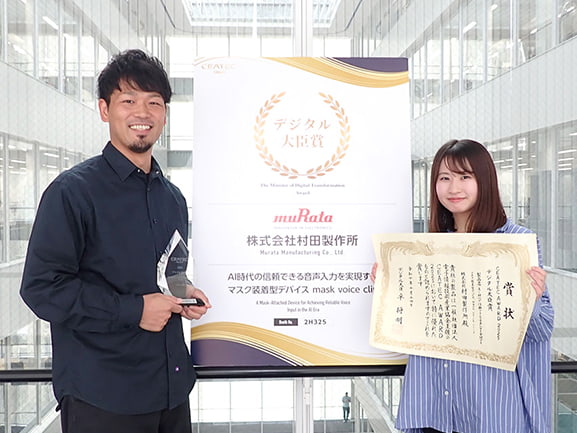
A revolutionary advance in voice input less affected by noise clipped to a mask, mask voice clip is an input device that isolates the wearer’s voice
Mask voice clip is a voice input device clipped to masks for highly accurate real-time voice isolation even in noisy environments.
We seek parties interested in this technology, those with ideas for potential applications, and those who might consider voice input deployment in medical settings, manufacturing, or construction.more
-
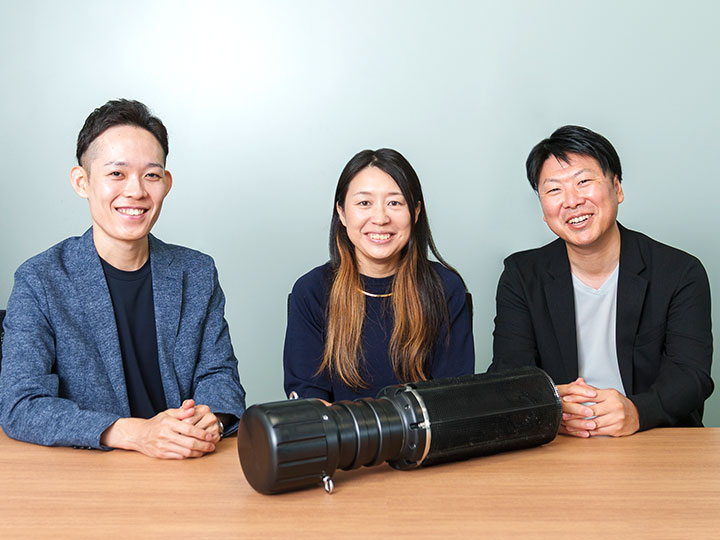
Development of a measuring device that makes it possible to visualize the amount of CO2 in seaweed beds "Underwater CO2 measurement and evaluation service" revolutionizes evaluation of blue carbon
Murata's underwater CO2 concentration measuring device enables easy and highly accurate measurement of CO2 in the ocean. Continuous measurement of underwater CO2 concentration has traditionally been considered difficult, so, by making it more accessible, this device holds the potential to greatly change methods for evaluating blue carbon. We are seeking partners for collaboration, including businesses, organizations, and others facing challenges in evaluating blue carbon, as well as companies and others interested in carbon credit trading.
more
-
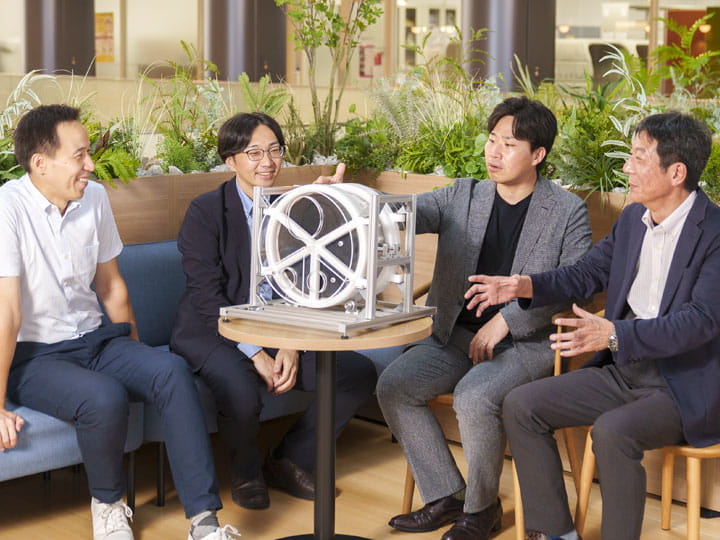
Decentralized exhaust gas circulation one-by-one VOC removal system - Utilizing a compact and lightweight rotor to achieve both energy saving and VOC removal
In order to downsize exhaust circulation concentration systems that treat VOCs, we have achieved downsizing and weight reduction of 20-30% or more for the core component, the rotor. We are looking for collaboration partners who can work together with us to create new VOC treatment solutions that utilize this rotor to achieve both energy savings and VOC removal.
more
-
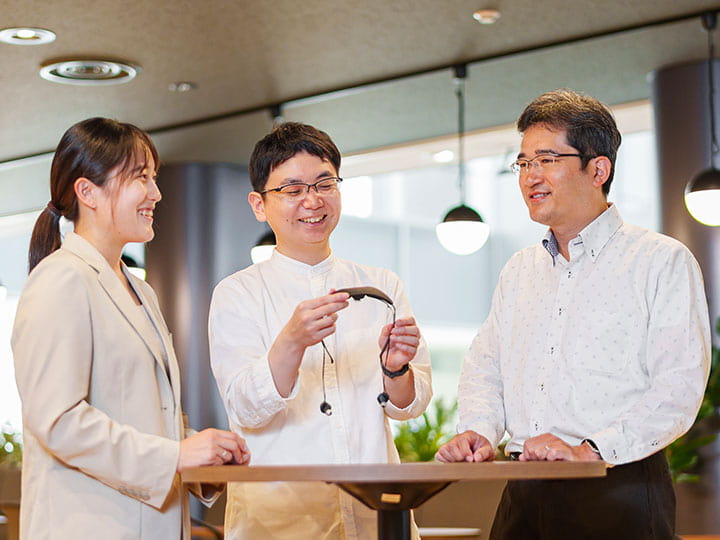
Brain NaviTM — A simple and high-precision brainwave analysis service that enables accurate “visualization” of momentary sensations and cognition
Brain NaviTM enables accurate understanding of human brain responses to stimuli such as seeing and hearing. We are looking for partners who seek to solve challenges by utilizing this analysis data to accurately personalize products and services.
more
-

Increasing the added value of products with ultra-thin, high sensitivity sheet-shaped temperature sensors called film thermistors
Murata has developed an ultra-thin sheet-shaped film thermistor with a thickness of 50 microns that can be freely bent or sandwiched and is capable of real-time, multi-point temperature measurement of objects. We are seeking partner companies that wish to develop new products utilizing this technology or that want to make use of it in thermal analysis to solve challenges.
more
-

NeuroStoneTM 3D-printed small free-form inter-connected ceramic devices
NeuroStoneTM is a 3D-printed, free-form inter-connected ceramic circuit board that enables freely three-dimensional internal wiring, thanks to Murata' s expertise in material development and co-firing. We are seeking partners to collaborate with us in leveraging this small free-form inter-connected ceramic 3D printing technology to create products that contribute to equipment downsizing and less invasive medical care.
more
-
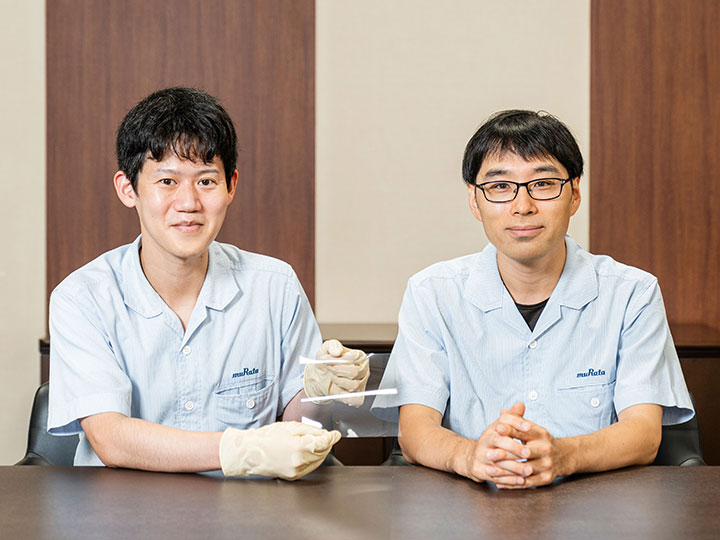
Transparent conductive film using the new material of MFT that can be both conductive and freely shaped
Murata Manufacturing is looking for partners to create new value together with us by utilizing bendable transparent conductive film and transparent conductive film that can be adapted to complex shapes using the new material of MFT (*in-house name).
more
-

Lithium-ion secondary battery characterization and degradation diagnosis solution
We are looking for collaboration partners, who are aiming to use batteries safely and efficiently by utilizing battery characterization and deterioration diagnosis technology to non-destructively measure the capacity deterioration factors and resistance increase of Lithium-ion secondary batteries.
more
-

Quadruple the power of lithium ion secondary batteries with porous current collectors
We are looking for co-creation partners for the development of porous current collectors and their implementation into lithium ion secondary batteries that would achieve the fourfold power generation compared to that of the conventional lithium ion secondary batteries.
more
-

Magnetorheological Elastomer (MRE) That Can Reproduce Hardness from Marshmallows to Erasers
Murata Manufacturing is looking for partners who can collaborate with us to create new products and applications by using the magnetorheological elastomer (MRE) material whose hardness changes when a magnetic field is applied to it.
more
-

Exclusive Acoustic Metamaterial from Murata Manufacturing - Ultrasound Transmission Metamaterial technology that enhances the ultrasound transmission through materials
Murata Manufacturing is looking for creative partners that increase the transmittance of ultrasonic waves to enhance the functionality of their devices and open up new markets.
more
