

- HOME
-
Collaboration Partner Recruitment
- mask voice clip
- Underwater CO2 measurement and evaluation service
- Decentralized Exhaust Gas Circulation one-by-one VOC removal system
- Brain NaviTM Brainwave Analysis Service
- Film thermistor
- NeuroStoneTM
- Transparent Conductive Film
- Lithium-ion secondary battery characterization and degradation diagnosis solution
- Next-generation lithium ion secondary batteries
- Magnetorheological Elastomer (MRE)
- Ultrasound Transmission Metamaterial
- Collaboration Partner Recruitment Top
- New Business Creation Initiatives
- Activity Introduction
- Notices
We have ended our recruitment of collaboration partners for the acoustic sensors.
Slim, high-sensitivity,
low-noise acoustic sensors for
measuring biological or mechanical
sounds
We welcome partners interested in taking on social issues together with slim,
high-sensitivity, low-noise acoustic sensors.
-
Description
Partners interested in taking on social issues together with slim acoustic sensors
-
Products used
Coin-sized acoustic sensor providing superb low-frequency (10-2,000 Hz) measurement
*This product is under development.Therefore, the product specifications are subject to change without advance notice.
MATCHING
POINT
- ・Companies interested in health monitoring device development
- ・Companies or healthcare professionals facing challenges associated with remote auscultation
- ・Companies seeking a partner in applying acoustic sensors in low-frequency measurement, such as for acoustic diagnosis using mechanical vibration

As society rapidly ages and faces greater likelihood of healthcare strain from outbreaks and physician shortages, we are called on to reduce risks of serious illness through early detection supported by remote health monitoring or routine home monitoring of biological sounds. Murata Manufacturing has developed promising technology in response. This coin-sized wearable acoustic sensor can be used in devices for constant high-sensitivity, low-noise measurement of biological sounds such as lung, heart, or bowel sounds.
Targeting frequencies from 10 to 2,000 Hz, it can detect subtle changes in sound.
Murata seeks partners for joint development of solutions for early detection of abnormalities through this continuous monitoring of biological sounds or mechanical vibrations. We welcome inquiries from interested parties.
Sensor highlights: slim, low-noise
The new acoustic sensor is a contact sensor module that picks up low-frequency sound (10-2,000 Hz) from the target area it is next to. Original Murata technology has enabled a high-precision wearable sensor with superb sensitivity and a high S/N ratio in a slim, low-profile module.
Low-noise despite being 2 mm thin and as small as a coin
The acoustic sensor applies many years of Murata knowledge and expertise in piezoelectric elements to overcome traditional challenges in making sensors both slim and highly sensitive.
It offers high sensitivity and a high S/N ratio in a 2-mm-thin module slightly smaller than a 10-yen coin.
 Smaller than a 10-yen coin
A high-sensitivity contact sensor for health monitoring
Unlike modules such as the condenser or MEMS microphone in most acoustic sensors, for which surface vibrations on the body are measured as vibrations of sound waves in the air, the Murata acoustic sensor is in contact with the area for sensing. This eliminates the medium of air, enabling direct, accurate sensing. It also enables sensing with an adhesive sensor instead of one that users press against their body, which has been difficult to achieve.
This makes the module especially suitable for biological sound monitoring. Smaller and slimmer than modules that measure through the air, it can be worn longer without discomfort, supporting easier continuous acquisition of highly accurate data over longer periods than before.

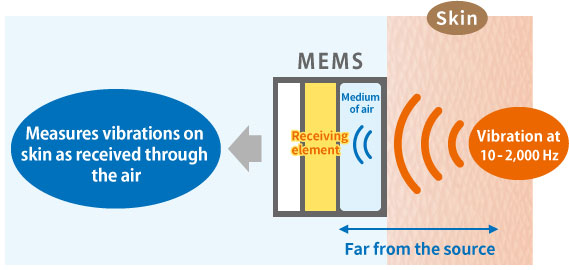
Differences between contact sensing and sensing through the air
Excellent low-frequency (sub 2 kHz) sensitivity
The Murata acoustic sensor excels at frequencies below 2 kHz, specifically 10–2,000 Hz. Many biological sounds lie across this range, including murmurs and other heart sounds, respiratory sounds from alveolar or tracheal/bronchial breathing, adventitious sounds such as snoring, crackles and crepitations, or whistling, and intestinal sounds from peristalsis. Besides biological sounds, this frequency band also encompasses sounds from motors, pumps, compressors, and other sources of mechanical vibration. The sensor is a promising solution for monitoring low-frequency sounds in a range of applications.
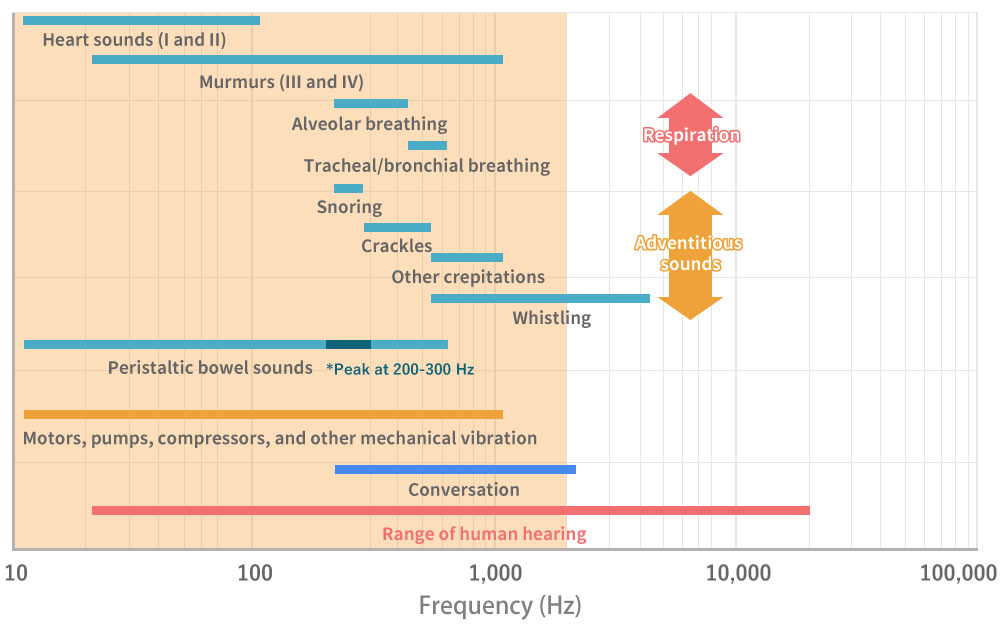
Target frequency range
Note: Opinions vary about specific frequency ranges of each sound
Anticipating future healthcare
As society rapidly ages and faces greater likelihood of healthcare strain from outbreaks and physician shortages, we are called on to reduce risks of serious illness through early detection supported by remote health monitoring or routine home monitoring of biological sounds.
Helping people stay healthy through biological sound monitoring
These conditions inspired the development of the acoustic sensor, which can be used in biological sound monitoring systems to shed light on the wearer’s health. Real-time health monitoring is possible as vital sounds from cardiovascular, respiratory, or other organs are picked up continuously and clearly by the slim, low-profile acoustic sensor on a wearable device.
Building the infrastructure for biological and mechanical sound analysis
The pandemic has now subsided, but these systems can prepare us for future outbreaks or sudden changes in health conditions. It can play a vital role in remote medical infrastructure. Beyond health, the sensor also shows potential in industrial applications: machinery and equipment maintenance, infrastructure inspection, production quality control, and factory automation.

Message from the developers
Murata Manufacturing Co., Ltd.
- New Business Incubation Department, Business Incubation Center, Corporate Technology & Business Development Unit
- Hirohumi Watanabe
- New Business Incubation Department, Business Incubation Center, Corporate Technology & Business Development Unit
- Hiroyuki Komatsu
Contributing engineers Hiroyuki Komatsu and Hirofumi Watanabe describe sensor achievements, potential applications, and benefits of collaboration.
QWas it challenging to make the sensor slim and reduce noise?
The slimmer the sensor, the less sensitive it is, which makes it hard to pick up the required biosignals that are below 2 kHz. And because these signals are very subtle, they’re susceptible to sensor noise. Solving these problems took insight from filter circuit design and expertise gained over many years of working with piezoelectric elements.

QWhat applications of this technological solution can we expect in the future?
Wearable biosound monitoring devices with this acoustic sensor can reveal changes in biosound data over time. Until now, obtaining this data has been considered quite difficult. We hope the data can be used in systems developed for early detection of disease or changes in health risks. We’re also exploring applications in fields other than healthcare.
QAre you excited by the prospects of bringing companies and technologies together?
The great advantage when companies collaborate is that they can share their own unique perspectives and outlooks on social issues. New ideas of all kinds arise when social issues come into view. Although we’re often still learning as we go, we push ahead with technological development with the belief that our persistent desire to explore new technologies will lead to unexpected discoveries. In any case, we’ll be taking on new social issues together through this collaboration.

We have ended our recruitment of collaboration partners for the acoustic sensors.

Inquiries
Murata Manufacturing is looking for research institutions, companies, and other organizations who are in the relentless pursuit of innovation and interested in turning ideas into unique solutions that could quite possibly shape the future of electronics and our global society.
*This product is under development.Therefore, the product specifications are subject to change without advance notice.
Project Examples for Collaboration
-

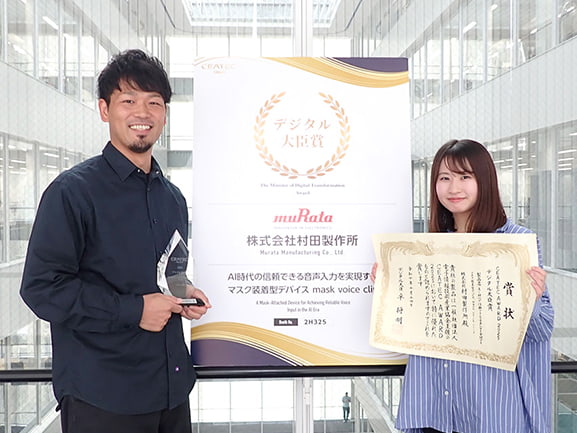
A revolutionary advance in voice input less affected by noise clipped to a mask, mask voice clip is an input device that isolates the wearer’s voice
Mask voice clip is a voice input device clipped to masks for highly accurate real-time voice isolation even in noisy environments.
We seek parties interested in this technology, those with ideas for potential applications, and those who might consider voice input deployment in medical settings, manufacturing, or construction.more
-
Development of a measuring device that makes it possible to visualize the amount of CO2 in seaweed beds "Underwater CO2 measurement and evaluation service" revolutionizes evaluation of blue carbon
Murata's underwater CO2 concentration measuring device enables easy and highly accurate measurement of CO2 in the ocean. Continuous measurement of underwater CO2 concentration has traditionally been considered difficult, so, by making it more accessible, this device holds the potential to greatly change methods for evaluating blue carbon. We are seeking partners for collaboration, including businesses, organizations, and others facing challenges in evaluating blue carbon, as well as companies and others interested in carbon credit trading.
more
-
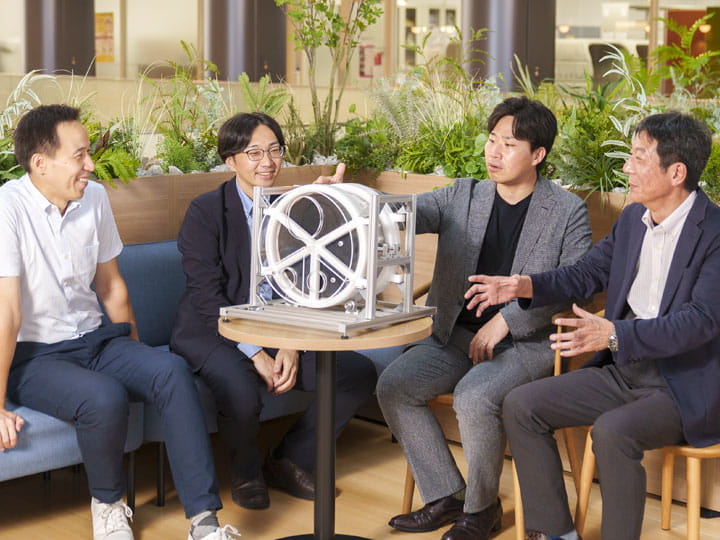
Decentralized exhaust gas circulation one-by-one VOC removal system - Utilizing a compact and lightweight rotor to achieve both energy saving and VOC removal
In order to downsize exhaust circulation concentration systems that treat VOCs, we have achieved downsizing and weight reduction of 20-30% or more for the core component, the rotor. We are looking for collaboration partners who can work together with us to create new VOC treatment solutions that utilize this rotor to achieve both energy savings and VOC removal.
more
-
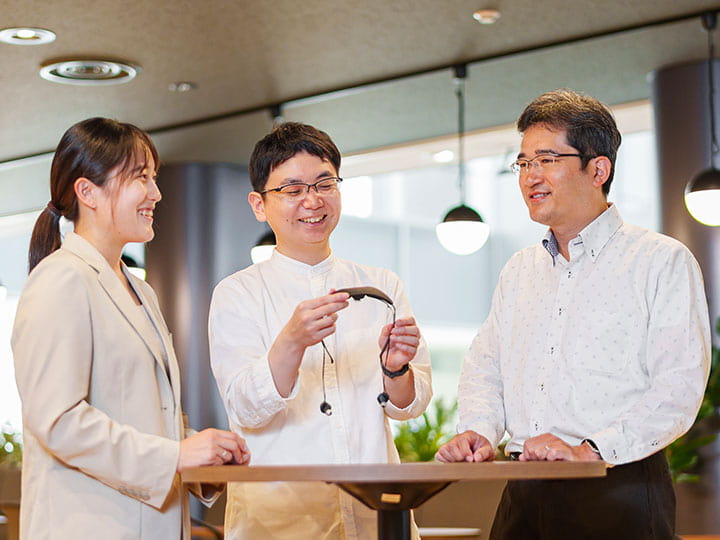
Brain NaviTM — A simple and high-precision brainwave analysis service that enables accurate “visualization” of momentary sensations and cognition
Brain NaviTM enables accurate understanding of human brain responses to stimuli such as seeing and hearing. We are looking for partners who seek to solve challenges by utilizing this analysis data to accurately personalize products and services.
more
-

Increasing the added value of products with ultra-thin, high sensitivity sheet-shaped temperature sensors called film thermistors
Murata has developed an ultra-thin sheet-shaped film thermistor with a thickness of 50 microns that can be freely bent or sandwiched and is capable of real-time, multi-point temperature measurement of objects. We are seeking partner companies that wish to develop new products utilizing this technology or that want to make use of it in thermal analysis to solve challenges.
more
-

NeuroStoneTM 3D-printed small free-form inter-connected ceramic devices
NeuroStoneTM is a 3D-printed, free-form inter-connected ceramic circuit board that enables freely three-dimensional internal wiring, thanks to Murata' s expertise in material development and co-firing. We are seeking partners to collaborate with us in leveraging this small free-form inter-connected ceramic 3D printing technology to create products that contribute to equipment downsizing and less invasive medical care.
more
-
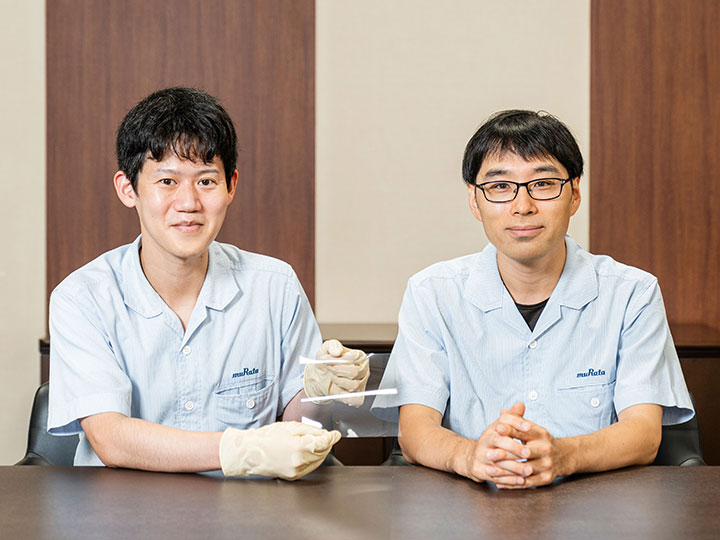
Transparent conductive film using the new material of MFT that can be both conductive and freely shaped
Murata Manufacturing is looking for partners to create new value together with us by utilizing bendable transparent conductive film and transparent conductive film that can be adapted to complex shapes using the new material of MFT (*in-house name).
more
-

Lithium-ion secondary battery characterization and degradation diagnosis solution
We are looking for collaboration partners, who are aiming to use batteries safely and efficiently by utilizing battery characterization and deterioration diagnosis technology to non-destructively measure the capacity deterioration factors and resistance increase of Lithium-ion secondary batteries.
more
-

Quadruple the power of lithium ion secondary batteries with porous current collectors
We are looking for co-creation partners for the development of porous current collectors and their implementation into lithium ion secondary batteries that would achieve the fourfold power generation compared to that of the conventional lithium ion secondary batteries.
more
-

Magnetorheological Elastomer (MRE) That Can Reproduce Hardness from Marshmallows to Erasers
Murata Manufacturing is looking for partners who can collaborate with us to create new products and applications by using the magnetorheological elastomer (MRE) material whose hardness changes when a magnetic field is applied to it.
more
-

Exclusive Acoustic Metamaterial from Murata Manufacturing - Ultrasound Transmission Metamaterial technology that enhances the ultrasound transmission through materials
Murata Manufacturing is looking for creative partners that increase the transmittance of ultrasonic waves to enhance the functionality of their devices and open up new markets.
more
